Friday, March 10, 2006

What's Muslim for Democracy?

Yes, that title sounds stupid. But often, especially since 9/11, folks have said, especially in the US press, that Muslims have never had democracy; heck! they don't even have their own word for it and use "Demokratiya" in Arabic. Now I am not an Arabic scholar or even a speaker of the language. (Though the fact that the last word in Libya's official name isn't that comes to mind: the People's Libyan Arab Gamahiriyya.)

But I do know that the Muslims of South Asia--fully half of the global Ummah, so to speak--have had a live tradition of consensual government. And especially since the days of resistance to colonial rule, we've had much more than that; we've had a rich literature of popular engagement in governance. All this came up because, in relation/reaction to the recent blocking of blogs in Pakistan, the following couplet from the person that Pakistan designates its national poet, (and who also wrote India's most popular national hymn also, by the way) was echoing in my head; and of course, I had to do an English translation to put on my blog:

sulthani-e-jamhoor ka athaa hai zamaana
joe naqsh-e-kohan thum koe nazar aayay mita dho!

comes, now, the era of the people's sovereignty
whatever sign of oppression you see, erase it!

The word we use is "Jamhooriyath", which comes from Jamhoor, as in "sulthani-e-Jamhoor" above; just as "Democracy" comes from the rule of the demos, the commons.

آدابAdaab,
فقیر-iiFaqeer


Technorati tags applicable to this post: - - - - - - - -

Thursday, March 09, 2006

Urdu goes places

Pupils in Scottish schools will be able to study Urdu at Higher grade
Pupils in Scottish schools will be able to study Urdu at Higher grade for the first time after a decade-long campaign by the Asian community to win academic recognition for the minority language. Scotland's exam body will introduce the new qualification from August 2007 following demand from Muslim communities and the schools they serve. It is the first time a non-European language has been recognised at Higher.Urdu is already available at Standard Grade following a decision in 1994 by the former Scottish Office, but the move to approve a Higher qualification is seen as particularly significant by campaigners.Other community languages such as Punjabi, Chinese, Arabic and Farsi are not taught at this level.
~~~~~~~~~~~~~~~~~~~~~~~~~~~~~~~~~~~~~~~~~~~~

South African Urdu Poetess of Indian origin - Rookeya Saloojee wrote Urdu couplets on South African anti-apartheid movement which are getting rave reviews. She also wrote 'naaths' (poems in praise of the Prophet Mohammad - PBUH), ghazals that were traditional love poems and protest anthems.

Rookeya composed her work - "Ode to 'Madiba'" on being inspired by Nelson Mandela when she visited him while he was at Robben Island prison. "Madiba" is the name by which Mandela is affectionately known to people of South Africa.

~~~~~~~~~~~~~~~~~~~~~~~~~~~~~~~~~~~~~~~~~~~~

ANJUMAN Muhibban-e-Urdu Hind Qatar (AMUHQ), an Urdu organisation of Indian expatriates affiliated to the Indian Cultural Centre (ICC) under the aegis of the Indian embassy, held a Mushaira dedicated to famous Urdu poet Mirza Ghalib.

Read on for details


~~~~~~~~~~~~~~~~~~~~~~~~~~~~~~~~~~~~~~~~~~~~

Science Aur Kainat Society of India, a national level voluntary organisation working for the popularisation of science and technology for the last 20 years organised the release ceremony of the first issue of its monthly Urdu tabloid Science Aur Kainat at an impressive function in the Assembly Hall of AMU Boys Polytechnique on 16 April 2005.

Read Complete Story

Thursday, March 02, 2006

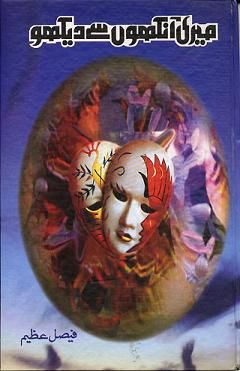
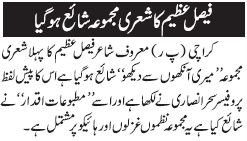
Mairee Aankhon Say Dhaikhoe; Look Through My Eyes...


From Cemendtaur, who is currently in Karachi:
'Meri AankhoN say dekho' (See it through my eyes), a book by young Bay Area poet Faisal Azeem has been published. The preface is written by Sahar Ansari. I will try to upload the title page and news of this publication. In Karachi, 'Meri AankhoN say dekho' is available at Welcome Book Port & Fareedsons, Urdu Bazaar; in North America, at this moment it is available through me--will try to put it at various online bookstores.

Congratulations to Faisal Azeem for reaching this very important milestone in his life.


آدابAdaab,
فقیر-iiFaqeer


Technorati tags applicable to this post: - - - -

Wednesday, February 22, 2006

Urdu Press: The Need to Come Out of Ghettos

Recently I came across an edit from the Times of India, which speaks, among other things, about the narrow and defeatist attitude the Urdu media (read Urdu dailies) has been exhibiting since long. This isn’t a good idea for the simple fact that Urdu media (like any other media) plays a very vital role in developing the mindset of its audience, which mostly comprise of the Urdu speaking Indian Muslims.

While it’s the responsibility of the media to highlight any lapses on the part of establishment, continuously brooding over the ‘pathetic state’ can go on to cultivate a negative mind frame of its readers, which can and does hamper the growth of community in particular and nation in general.

Instead of toeing a fanatically-religious and anti-secular line, the Urdu media must once again go on to become what is was during the revolution of 1857 i.e. free, secular, progressive, and above all revolutionary.

By changing its attitude, the Urdu media can very well be instrumental in breathing a new zest in its audiance.

As Iqbal would say: Teri Khudi main agar inqalaab ho paida, ajab nahi ke yeah chaar sou badal jayey.

BTW, in the edit I learned about Maulvi Mohammed Baqar, who was the first journalist to be martyred during the uprising of 1857. And yes, he was an Urdu journalist.

I am reproducing the TOI edit below for the benefit of readers:

http://timesofindia.indiatimes.com/articleshow/msid-1369931,curpg-1.cms

Every morning I open the Urdu newspapers with dread. Will I have to read yet another regressive rant by those who call themselves the custodians of Islam, or one more litany on the wrongs done to the Muslim community worldwide?

Sadly, the answer is yes. What better example of this kind of bigotry than the headline in the Urdu Times on January 9: 'Sharon ki maut par jashn manaya jayega' (Sharon's death will be celebrated)?

Muslims, madrassas, reservations in a Muslim university, a mosque under threat, another lavish one being built, Muslims being oppressed from Kashmir to Kandahar and Baghdad to Bradford, Bosnia, Palestine, Afghanistan.

These are the staples that Urdu dailies thrive on. It appears as if nothing else in the world is newsworthy unless it has Muslims at its centre, preferably in a situation of victimhood.

But a paper is a hard habit to break, no matter how parochial, bland or offensive. And it is also unfair to tar all the Urdu dailies with the same green brush.

But since Hyderabad's leading Urdu daily Siasat is hosting the World Urdu Conference between January 14 and 16, it is an excellent opportunity for leading dailies and their readership to do some introspection and take a hard look at the fare being dished out everyday.

This exercise might be more constructive than breast beating about the tardy treatment meted out to the Urdu language by an apathetic government.

Urdu, the epitome of our 'Ganga-Yamuni tehzeeb' (composite culture), is in its death throes. And nowhere is the decay more pronounced than its press, once the sentinel of freedom of thought and speech, mores and conduct. Urdu journalism prided itself on its glorious past.

If Maulvi Mohammed Baqar, an Urdu editor in Delhi, became the first Indian journalist who was martyred during the 1857 rising, Urdu journalists and writers like Maulana Azad, Maulana Mohammed Ali and Maulana Hasrat Mohani suffered rigorous imprisonment for opposing the British raj.

The spirit of Urdu, and its press, before it was trussed into a religious achkan, was secular, its tone revolutionary and progressive. It was never a language of the Muslims.

Munshi Prem Chand, Pandit Ratan Nath Sarshar, Krishen Chandar, Rajinder Singh Bedi and Josh Malsiyani were leading exponents of the language. How many Hindus does Urdu need to flaunt to prove its appeal across religions?

Urdu has enriched Hindi cinema immensely, providing mellifluous lyrics and embroidering dialogue. Yet regular reading of Urdu dailies is a lesson in looking at the world through the exclusive prism of Islam.

Like some Hindi rags, they too have begun to thrive on sensationalism. There are half a dozen leading Urdu dailies.

Interestingly, Hind Samachar, owned by a Hindu business family of late Lala Jagat Narain, is the largest circulated Urdu daily with a circulation of over one lakh. Urdu is historically linked with Indian Islam.

A bulk of Islamic tradition is in it. But to Islamise Urdu is to subvert the language's inclusive character — one that resulted from the intermingling of soldiers from different countries, which is why Urdu means camp.

Nobody paid a bigger price for Partition than Urdu. Pakistan, in its desperation to acquire legitimacy, appropriated Urdu and its poet Allama Iqbal.

Urdu became Pakistan's national language while Iqbal, who gave us Sare Jahan Se Achcha..., was turned into Pakistan's founder-thinker. Hindutva's hate-Urdu campaign became part of the anti-Muslim tirade.

The opportunist policies of the Congress governments only fuelled anti-Urdu campaigns. Urdu became a stranger in its own home.

Driven out of secular government schools, it found shelter in the insular, exclusivist madrassas and moribund maktabs. Like the commu-nity which patronised it, it became a minority.

It became the politicians' favourite plank to get Muslim votes. Dwindling revenue, caused by a shrinking readership, has pushed the Urdu press virtually into the hands of regressive forces.

There are some exceptions, but dissenting views and progressive ideas are mostly blacked out of the Urdu press. Is this issue also on the World Urdu Conference's agenda?


P.S. This edit appeared in the Times of India before the mentioned World Urdu Conference happened in Hyderabad, in the month of January, 2006.

Wednesday, February 15, 2006

PhotoBlogging Cartoon Protests in Karachi

For people who don't often get a chance to read banners in Urdu--or are nostalgic for it--here's an interesting chance:

As the protests against "Those Cartoons" move ("spread" doesn't seem appropriate) into Karachi, Pakistan's largest city, Cemendtaur is covering them on the Karachi Photo Blog. He's posting reports from the day on the Photo Blog. You can start at:

http://karachiphotoblog.blogspot.com/2006/02/cancel-your-trip-danish-cartoonists.html


and following on from there:

http://karachiphotoblog.blogspot.com/

Monday, February 13, 2006

Online Urdu Newspapers

Etemad - Hyderabad's youngest Urdu daily is already into circulation now. It is being brought out by a famous Muslim Ex-parliamentarian - Sultan Salahuddin Owaisi. Nasim Arifi has been appointed as the editor of Etemad.

Hyderabad already had three Urdu dailies - Siasat, Munsif and Rehnuma-e-Deccan. With the launch of Etemad, the quality of Urdu journalism is definitely going to improve, day by day.

Another good thing is that at least three of above mentioned newspapers also have their presence on the Internet. They can be read online on the following URLs are -

Aadaab,

~ Qais

Sunday, February 12, 2006

Urdu Tech News: "The Marriage of Google Mail and Google Talk"

I have mentioned Urdu Tech News here before:

http://urdu-ke-naam.blogspot.com/2005/09/urdu-tech-news-new-blog.html

I haven't been able to contribute to it much. But the other folks are doing good work, if a little slowly. And they're having fun with it! Take the following post; a headline like the one at the top of this post would not be out of the ordinary, right? But Shoaib Safdar has taken that and written pretty much the same thing in Urdu--with very interesting results! I guess it will take a while for us--or me, at least--to get so comfortable with this kind of thing in Urdu to take this kind of thing in my stride. Until then, it's rather endearing; enjoy!

http://urdutechnews.blogspot.com/2006/02/blog-post.html

I mean, the traditional way to say that would be "GMail aur Google Talk ka milaap", but Shoaib takes it a step further, to "GMail aur Google Talk ka biyaah".

Hey, what can you do! It's a brave new world, this blogosphere; and new ways of expressing ourselves are the whole point, no?

آدابAdaab,
فقیر-iiFaqeer

Tuesday, December 20, 2005

DoorDarshan Urdu Update

We'd talked about DoorDarshan staring an Urdu channel:

http://urdu-ke-naam.blogspot.com/2005/07/urdu-news-channel-by-prasar-bharti.html

Here's an update:

http://www.indiantelevision.com/headlines/y2k5/dec/dec161.htm

It's taken almost three generations, but it is good to see Urdu increasingly getting its props in India. We need to get to the point where the culture that the language represents really rises above the divide between India and Pakistan. Yes, I know we cherish poets across the border and give them great honors when they visit; but that's my point. We need to get to the point where it is not mentionable that a poet is Indian or Pakistani. When a poet from Britain visits the US or Australia, or vice versa, it is not a big deal which country he or she is from; he is a great poet in the language spoken in both places. That's how it should be.

Monday, October 31, 2005

Azad Karachi Radio Program 003, October 31, 2005

Program 3 of Azad Karachi Radio continues discussion of the earthquake in South Asia and discusses issues of democracy, civilization and the role of the World Bank and the Military.

You can hear the program, or get information on how to subscribe to the Podcast here.

آدابAdaab,
فقیر-iiFaqeer

Friday, October 28, 2005

Siasat Group: A Vanguard for Urdu

Siasat, an Urdu daily published from Hyderabad, has been a vanguard in the world of Urdu media and journalism. It was also the market leader in terms of readership, till one Munsif Daily made a heroic comeback - after it was taken over by a Chicago based businessman - and gave Siasat a tough competition.

Siasat was founded by a philanthropist and educationist - Abid Ali Khan, the man who dedicated his life for the welfare of the masses. Mr. Khan had the vision of promoting social welfare and harmony, and for the purpose Siasat Daily was very much instrumental. For his contribution to his community and the country, he was awarded with one of the prestigious civilian award by the Govt. of India - "Padmashree."

Among other remarkable things that the Siasat Group is involved in, one of their works is highly commendable i.e., the education of Urdu. Today, the group is, in itself, an institution of Urdu. It's not only involved in promoting Urdu education, but is also involved in organizing related cultural activities, like "Mushairas" - a gathering of poets.

To my knowledge, the Group runs Abid Ali Khan Educational Trust Urdu Classes, where tremendous effort are made for educating students in Urdu. Things like Urdu Calligraphy, Urdu Software, etc is taught to the students interested in the language.

Other than Urdu, the Siasat Group continues its good work on many social fronts. Visit the webpage below to read a note from Siasat's current Editor in Chief: Mr. Zahid Ali Khan.

http://www.siasat.com/english/index.php?option=content&task=view&id=63&Itemid=75&cattitle=Useful%20Links

Siasat's online edition: http://www.siasat.com/

Thursday, October 20, 2005

Azad Karachi Radio Program 002 now available

The second program of Azad Karachi Radio (I mentioned it last week) has just been uploaded. Please take a look and provide feedback:

Azad Karachi Radio is an Urdu language audio program available on the web. Published under the Azad South Asia banner, this program covers, politics, poetry, and life. The first two programs are now available at:

http://AzadKarachiRadio.blogspot.com


You can subscribe using podcasting software using the address:

http://feeds.feedburner.com/AzadKarachiRadio

Azad Karachi Radio is also available for online listening via Yahoo!s new (Beta) Podcasting service at:

http://podcasts.yahoo.com/series?s=3d848ad579b260b163d17218e7fcbad5

آدابAdaab,
فقیر-iiFaqeer

iFaqeer on Sahir Ludhianvi; Now in Audio

As a pilot for podcasting on my personal blog, I took the speech I gave a little while ago on Sahir Ludhianvi (see this and this), stuck an English introduction at the beginning and uploaded it. You can hear it here.

آدابAdaab,
فقیر-iiFaqeer

Thursday, October 13, 2005

Urdu Blogs on the 'Quake

As some readers will know, there's now an extensive section about the quake-related information on WikiPakistan. (See my post on my personal blog.) One of the pages there collects personal accounts from the ground:

http://pakistan.wikicities.com/wiki/Earthquake_10-05_Personal_Accounts


Wouldn't it be a good idea to collect links there to Urdu (and English) blogs of people on the ground, both affectees and those involved in relief work, fundraising, etc.? It would give Urdu-speakers (and other people) around the world a chance to get a first hand view.

آدابAdaab,
فقیر-iiFaqeer

Tuesday, October 11, 2005

Azad Karachi Radio; a New Urdu Language Podcast

We've launched a new Urdu Language Podcast with the title "Azad Karachi Radio". Check it out at:

http://AzadKarachiRadio.blogspot.com/

You can subscribe to the RSS feed using the following address:

http://feeds.feedburner.com/AzadKarachiRadio

Please let us know what you think.

For Azad South Asia,

آدابAdaab,
فقیر-iiFaqeer

Wednesday, September 21, 2005

"Installing Urdu" on Windows XP

This blogger, in particular, has made a lot of noise about blogging in Urdu and I promised instructions on how to install Urdu as a language that your Windows XP machine can handle. Here are the instructions, from the website of the Center for Research in Urdu Language Processing in Pakistan:

http://www.crulp.org/Downloads/read_me_xp.txt

Once you have followed those instructions, you can use Urdu not just for blogging, but for pretty much anything you now use English and the English script for on your computer. And as I have said before, no, it is not the same as using InPage or some other editor to write Urdu, but using Urdu all the time. With the InPage solution (which is wonderful for "kitaabath" and page layout), what you have to do is convert your text in to a graphic and put it on your website or page, etc. But with this procedure, you can actually write directly in your HTML file, or Word document--or even while chatting with people over Yahoo! Messenger, MSN Messenger or other IM client!

آدابAdaab,
فقیر-iiFaqeer

Wednesday, September 14, 2005

Urdu Tech News - A New Blog

I have been invited to join a new blog in Urdu about technical topics. It's at:

http://urdutechnews.blogspot.com/

Please check in once in a while to see what's happening.

آدابAdaab,
فقیر-iiFaqeer

Tuesday, September 13, 2005

Early Urdu Literary Culture and History

Someone just brought to my attention Shamsur Rahman Faruqi's Early Urdu Literary Culture and History

The first chapter, "History, Faith, Politics: Origin Myths of Urdu and Hindi" is available at the following page: http://www.columbia.edu/itc/mealac/pritchett/00fwp/srf/srf_early_urdu_ch1.html

آدابAdaab,
فقیر-iiFaqeer

Saturday, July 23, 2005

Is Urdu Ready for the Information Superhighway?

July's cover story in Spider magazine (the Dawn Group's Internet Magazine) is titled "Sifting Scripts: Is Urdu ready for the information superhighway?". One of the stories, by yours truly, covers how the blogosphere is evolving:

http://www.spider.tm/jul2005/cstory2.html


It mentions this blog rather prominently.

Highlights of the whole edition, including the full articles on Urdu on the 'Net are available off the Spider web page. The other stories in that package actually do a good job of rounding up what's been going on with the Internet and Urdu. And mine gives you a flavour of how Urdu is starting to transcend borders for a new generation.

آدابAdaab,
فقیر-iiFaqeer

Sunday, July 17, 2005

20th Volume of Urdu Lughath (Dictionary) Released

It seems the Urdu Dictionary Board has released Volume 20 of the dictionary they are compiling. They are halfway through "Noon", I think. This volume covers from "Nashaath" to "Nh. So I guess we will now know precisely what Faiz Saahab was talking about when he said "Chandh kaliyaaN Nishaath kee chun kar..."...or was it Sahir? But I wonder what "Nh" means? Is that just the "Nah", as in No?

I don't want to just steal a story from a news site and post it here, so please read the story on the sites that published them. I will post any other information I can get. For now, I just remember that back when I was in High School (late 80s), a friend of my father's, Professor Ikhlaque Akhtar Hamidi, mentioned contributing to the discussion. I am not even sure whether it was as a formal part of the Urdu Dictionary Board or not. Anyway, here are the stories:

* Story at "PakPositive" that quotes and links to a Gulf Times story.
* Story in Dawn.

آدابAdaab,
فقیر-iiFaqeer

Wednesday, July 06, 2005

Urdu News Channel by Prasar Bharti

India shall soon have a dedicated TV news channel in Urdu. This channel shall be a good source of news and information for the Urdu speaking populace of India. Besides, I believe this step shall also be instrumental in keeping the language more agile.

In India, most of the regional Doordarshan channels broadcast news in Urdu. Some private channels like Sahara TV runs Urdu news bulletin, as well. But having a complete channel for Urdu news would add great value to the Urdu media, and I believe, would to an extent conjugate Urdu and Urdu speaking people to the mainstream national life.

Talking about Urdu channels, Hyderabad based Enadu TV launched the first 24 hours Urdu channel: E TV Urdu. This is essentially a channel that has current affairs programs, news, and family entertainment. The channel is gradually gaining popularity among the masses.

Media has always been instrumental in creating and establishing cultures. So, with channels like E TV Urdu and to-be-launched Urdu channel from Prasar Bharthi, Urdu as a language is bound to become relatively more commonplace. And, this way, Urdu shall not be wrongly associated with any particular community or religion, and shall gain more reorganization as the language of India and all Indians - something that it always has been.

Following is the news about the channel.

Courtsey: deepikaglobal.com
http://www.deepikaglobal.com/search_newsdetail.asp?newscode=108380

Prasar Bharati to launch Urdu TV Channel in January next

New Delhi, June 24 (UNI): A new Urdu television channel is to be started by Prasar Bharati from January one next year, which Information and Broadcasting Minister S Jaipal Reddy said would be a new year gift to 100 million viewers in the country.

An amount of Rs 65.7 crore had been set aside to prepare the software for the new channel, Mr Reddy said at a press meet here.

He said that Prasar Bharati had accepted a request to this effect made by the Central Government.

The channel will beam at lest seven hours of programme every day to begin with, he said.
The Minister said there was no dearth of Urdu journalists in the country to help develop the channel.

While the channel was not being started keeping commercial viability in view, attempts would be made to earn revenue