Friday, March 24, 2006

Urdu poetry: Making inroads into Poland

Urdu poetry is making inroads into Poland, with the ghazals of renowned 19th century poet Mirza Ghalib being translated into Polish.

Anil Wadhwa, India's Ambassador to Poland, released a collection of Ghalib's poems, translated by Polish intellectual Janusz Krzyzowski and Surender Zahid, an Indian poet based in Warsaw.

More than 100 Polish writers, poets, critics, journalists and intellectuals apart from diplomats attended the ceremony held at the ambassador's residence.

The Indian Council for Cultural Relations (ICCR) financed the publication of Ghalib's ghazals into Polish.

Last year, Janusz and Surender translated works of 18th century Urdu poet Mir Taqi Mir into Polish, which also gained popularity in Polish literary circles.

Source: Mirza Ghalib is a hit in Poland : HindustanTimes.com

Tuesday, March 21, 2006

Metaphysics of Symbolism and Motivation for Life in Urdu Poetry

Ragon mein daurhte rehne ke hum nahi qayal;
Jab aankh hi se ne tapka to phir lahoo kaya hai…

One thing that makes Urdu poetry significantly different from other forms of literary expressions is the symbolism or metaphysical association of human emotions. The above couplets beautifully symbolize life's realities in terms of pains and sufferings. The symbolism depicted here metaphysically ascribes to blood (lahoo). And that blood epitomizes the highest degree of suffering and pain is quite understood!

The way pains and sufferings as part of our lives is visualized by the first line of the couplet: Ragon mein daurhte rehne ke hum nahi qayal. We can visualize life being full with pain and suffering in the same way as veins (rag, or ragon) are filled with blood. This line emphatically suggests that although life is full of pain and suffering, the pains and sufferings are not significant, at least in the eyes of the poet. The line translates as: It's the basic characteristics of blood to flow in the veins, and the poet does not subscribe to the importance of blood till it flows in the veins.

The beauty of the thought is brought out in the second line of the couplet: Jab aankh hi se na tapka to phir lahoo kaya hai [The blood holds no significance till it flows out from your eyes]. The couplet in tandem translates into the thought that though blood is significantly symbolic of suffering and pain, the symbolism is not brought out till it flows down your eyes!! In symbolism, majority of life's miseries, pains, and sufferings are insignificant; till they reach an acme [the acme being symbolized by the blood flowing out from your eyes].

Though different people might have different thoughts and logic to comprehend this couplet. To me, the above sentences would definitely describe the best translation of the couplet. This holds the window to the reality of life, by urging us to view pains and sufferings as insignificant till they reach their acme.

The next couplet in this ghazal by Ghalib represents his own state of mind as far as pains and sufferings are concerned:

Chipak raha hai badan par lahoo se pairaham;
Hamari jeb ko ab hajat-e-rafoo kaya hai.

To me, the translation of this couplet amounts to stating that his (the poet's) sufferings [the origin of which lies perhaps in his poverty and misery] are so intense that the sufferings themselves ensemble his respite - he does not need to mend his torn pocket, as his shirt sticks to his body because of the blood flowing!!

A note to conclude: Although a very nicely written and an excellent masterpiece of its kind, this ghazal lacks the basic motivation towards life. A marked difference between poets like Ghalib and poets like Allama Iqbal is that while the former category focuses more on presenting the situations of life, the later category concentrates on motivating people to continue living against all odds, for these odds are part of life.

"Nahin tera nasheman Qasr-e-Sultani ke gumbad par;
Tu shaheen hai, basera kar paharon ki chattano mein."

This couplet by Allama Iqbal sums up what I intend to conclude: If you are a man of courage, grit, and determination, and you want to stand out in the crowd; do not approach the easy way. On the contrary, prepare to lead a rock-sturdy life, which is characterized by hardships (paharon ki chattanein).

Upgrade Urdu: Muslims must not get left behind(COMMENTARY)

Upgrade Urdu: Muslims must not get left behind(COMMENTARY)

March 19, 2006
By Firoz Bakht Ahmed

The head of a government-run primary Urdu medium school made a shocking revelation in Delhi recently: Urdu books are not available till mid-September although schools open in summer and although Urdu is a second language in the city along with Punjabi.

And this is just one of the many problems confronting Muslims aspiring education.

Year after year, the abysmally low results in Urdu schools are indicative of the confusion among the managing bodies, principals, teachers, students and parents. This has resulted in a sharp decline in the academic levels of Indian Muslims.

As things stand, education is not a priority for Muslims for three reasons.

First, most of them are primarily agriculturists. Second, their belief that they are discriminated against in employment acts as a deterrent to higher education. Third, Muslim girls, till not so long ago, were not sent to school owing to social taboos.

Sparsely lit, dilapidated classrooms, poor sanitation, broken and decrepit furniture, unhygienic drinking water, lack of teachers, unconcerned parents and uninterested students are some of the features of the 10,000 beleaguered Urdu medium schools in India.

There seems to be a sort of conspiracy to downgrade Urdu by associating it with communalists and terrorists, forgetting that it is a language deeply entrenched in the composite heritage of India.

There seems to be a sort of conspiracy to downgrade Urdu by associating it with communalists and terrorists, forgetting that it is a language deeply entrenched in the composite heritage of India.

Ironically, Urdu has been kept alive by Hindi cinema, FM radio, madrassas and the occasional recitation of couplets from Ghalib, Iqbal and Faiz in parliament. A language does not prosper through such methods alone but by people who love it with sincerity.

More people should subscribe to Urdu newspapers and journals rather than getting these freely via mailing lists. Many popular children's Urdu magazines like Shama, Khilona, Toffee, Chandanagri and others have ceased publication for want of interest. They should be revived

Urdu officers could be appointed in the government's nodal agencies like municipal corporations, police departments and so on. Besides, there should be more Urdu learning centres and Urdu should be part of the syllabus of Kendriya Vidyalayas and Navodaya Vidyalayas.

The pass percentage in Delhi over the last two decades in the board exams in Urdu-medium schools fluctuates between 20 percent and 30 percent. In Rajasthan and Madhya Pradesh, the failure rate is identical to Delhi's 77 percent. The only state where Urdu-medium students do really well is Maharashtra where the pass percentage stood at 64 percent this year.

Most teachers in Urdu schools are found to be lackadaisical and unconcerned about both their jobs and students. As if this were not enough, the management bodies of those already victimised and harried backward institutions act as parasites rather than working towards rejuvenating the system.

The hapless students feel that their schools are completely responsible for their disastrous failure. Instead of doing something to upgrade Urdu and secure a better future for students, Muslim leaders keep diverting issues concerning Muslims in educational, social and economic fields to more political matters.

Children belonging to privileged Muslim families never study in Urdu schools. Rather they opt for missionary schools. Even those championing the cause of Urdu and occupying top positions in Urdu departments in universities and government offices prefer English-medium schools for their children.

Except the likes of Sir Syed, Muslims in general never bothered to establish good schools or colleges unlike the Christian missionaries.

Countrywide, every Urdu school has 10-12 vacancies in teaching jobs. No effort is made to fill them. A few Urdu schools do not even have their own buildings and are run in the open air.

Most schools do not have Urdu textbooks in subjects like science, geography and mathematics. Each year, textbooks fail to reach the market in time. When they finally do, the exams are over.

As India's largest minority, Muslims can't afford to be mediocre and spiritless. True, they should love Urdu but they must also make sure they are conversant in English and Hindi or one other regional language.

India is forging ahead but its Muslim population is still largely uneducated. More than anybody else, it is the responsibility of the Muslims to see that the community marches to a secure future.

( Firoz Bakht Ahmed is a commentator on educational and social issues. He can be reached at firozbakht@rediffmail.com)

Source: Indo-Asian News Service

Thursday, March 16, 2006

Holi Hay!

Last weekend was the festival of Holi, the (particularly North Indian) spring festival of the colors of life springing anew after the dead of winter. The festival itself is mostly seen as a Hindu festival, and mainly of Northern India--especially in these increasingly polarized and parochial times. Urdu also developed and grew in the region where this festival is celebrated and the theme of the festival itself and of colours, and of being coloured and painted in the hues of life and other truths is one that comes up often in Urdu poetry. This post is an attempt to gather a few examples and maybe start a conversation about it. Readers are requested to contribute their own pieces of Urdu literature that carry the theme. You can either email me, or post them here directly as comments.

The first is a quote from an Urdu qawwali where the poet--as Urdu poets are wont to--plays with layers of meaning and multiple themes and meanings, some coquettish, some mystical, some sublime, some sensual and erotic.

A couple of quick notes that might help the enjoyment of the first piece, and then I will get out of your way and let you enjoy the poetry:

The word "Sufi" is the thakhallus, the nome de plume and artistic signature of the poet. But, as is often the case, the playful pun on the meaning increases the depth, the pleasure, and the subversive meanings of the piece.

The theme of dyeing someting, or imbibing it with hues is a recurring one in Urdu poetry, especially the subaltern and proto-Urdu work of the likes of Khusrau and others and in Sufi-hued (excuse the pun) works out of South Asia generally. This carried both the subversive sub-text of glorifying the lowly manual labourer that the "rang-raiz" ("rangrajwa" in the language of Khusrau and my grandmother) was seen as, and the meaning of imbibing spiritual truths and being suffused with them like a cloth takes on the dye used to give it its color.

With that, here's the first piece:

NaheeN jis pay ishq ka kuch asar, bhala uss kee husn ki kyaa nazar
Usay kyaa basanth kee hoe khabar, joe ranga na jayay gulaal main

Mujhay Sufi saaf batha'iyay, na chupa'iyay na chhipa'iyay
KaheeN holi k-hailee hai aapnay, joe rangay hain kapray gulaal main

or, in quick and dirty English translation:

On whom Love has no effect; oh, what eye does such a person have on Beauty?
What does a person know of the Spring, who has not been painted in vermillion?

Tell me frankly, Oh Sufi, don't hide it, don't keep it hidden
You've played Holi somewheres; is that why your clothes are all coloured in vermillion?

On my request, Munir Saami Saahab of Toronto and places far, far East, was kind enough to send the following lines from Nazeer Akbarabadi. The piece is, I guess, though I would not swear by it, on a somewhat less profound level.

[Apologies for not being able to provide translations--it would take weeks to do the pieces justice. If anyone can contribute translations, please do.]

Hooaa jo aa kay nishaaN aashkaar Holi ka
Baja roobaab say mil kar sitaar Holi ka
Surood, Raqs hooaa bay shumaar Holi ka
Hansi Khooshi meiN barha karobaar Holi Ka
Zabaan pay naam hooaa baar baar Holi ka

Khooshi ki dhhoom say her ghar may rang banwaaey
Guulaal, abeer kay bhar bhar kay thhaal rakhwaaey
NashoN kay josh hooey raag o rang thheraaey
Jhuumaktay roop kay bun bun sawaang dikhlaaey
Hooaa huujoom ajab her kinaar Holi Ka

Gali meiN koochay meiN, ghuul shor ho rahey aksar
Pharrakney rang lagey yaar her gharri bhar bhar
Badan meiN bhheegay heiN kaprey guulaal chehroN per
Machi yeh dhoom to apnay gharoN say khhoosh ho kar
Tamaasha daikhney niklay nigaar Holi ka

Bahaar kaproN ki, her ik ko jab nazar aaee
Her Ishq baaz nay dil ki muraad bhar paaee
Nigah larraa kay puukaara her aik shaidaaee
MiyaaN yeh tuum nay jo poshaak apni dikhlaaee
Khoosh aayaa ab hameiN naqsh o nigaar Holi ka

Tuumhaarey daikh kay muukh per guulaal ki laali
Hamaarey dil ko hooee, her tarah ki khoosh haali
Nigah nay dee maa'ey guulrang kee bharee piyaali
Jo hans kay do hameiN piyaarey tuum iss gharree gaali
To hum bhee jaaneiN kay aisaa hay piyaar Holi ka

Jo kee hay tuum nay yeh, holi kee tuurfa tayaari
To hans kay daikho idhar ko bhee jaan yak baari
Tumhaari aan bohat hum ko lagti hay piyaari
Lagaa di haath say apnay jo aik pichkaari
To hum bhee daikheiN badan per singhaar Holi ka

Tuumhaarey milney ka, rakh ker hum apney dil meiN dhiyaan
Kharrey heiN, aass lagaa ker kay daikh leiN ik aan
Yeh khoosh dili ka jo thehra hay aan ker saamaan
Galey meiN daal kay baanheiN khooshi say tuum ay jaan
Pinhaao hum ko bhee ik dum yeh haar Holi ka

Uudhar say rang liyay aao tuum idhhar say hum
Guulaal abeer maleiN moonh pay ho kay khoosh her dum
Khooshi say boleiN, hanseiN , Holi khail kar baahum
Bohat dinoN say hameiN to tuumhaarey sir ki qasam
Issi umeed meiN thaa, intizaar Holi ka

BuutooN ki gaaliyaaN hans hans kay kooee sehtaa hay
Guulaal parta hay kaproN say rang behtaa hay
Lagaa kay taak kooee , moonh ko daikh rehtaa hay
Nazeer, Yaar say apney kharra yeh kehtaa hay
Maza dikhaa hameiN kuuchh too bhee yaar Holi ka

Munir Saahab followed that up with this, again from Nazeer, this time adding the comment that "the editors of the kuuliyaat have censored some juicy pieces. But even the left over is hot!"

Holi ki bahaareiN

Jab phaagan rang jhamaktay hoN, tub daikh bahaareiN Holi kee
Aur duff kay shor kharraktay hoN, tub daikh bahaareiN Holi kee
PariyoN kay rang damakaty hoN, tub daikh bahaareiN Holi kee
Khhuum, sheeshay, jaam chhalaktay hoN, tub daikh bahaareiN Holi kee
Mehboob nashay meiN chhaktay hoN, tub daik bahaareiN Holi kee

Ho naach rangeeli pariyoN ka, baithay hoN gulroo rang bharay
kuuchh bheegi taaneiN holi ki, kuuchh naaz o adaa kay dhhang bharay
Dil phoolay daikh bahaaroN ko, aur kaanoN meiN aahang bharay
Kuuchh tablay kharrkeiN rang bharay, kuuchh aish kay moonh dum chang bharay
Kuuchh ghoongroo taal chhanaktay hoN, tub daikh bahaareiN Holi kee

Saamaan jahaaN tak hota hay, iss ishrat kay matlooboN ka
Woh sab saamaan moohaiyaa ho, aur baagh khuula ho khooboN ka
Her aan sharaabeiN dhalti hoN, aur tthutthh ho rang kay dooboN ka
Iss aish, mazay kay aalam meiN, ik ghaul kharra mehboobooN ka
KaproN per rang chirraktay hoN, tub daikh bahaareiN Holi kee

Guulzzar khuulay hoN pariyoN kay, aur majlis ki tayyari ho
KaproN per rang kay chheentoN say, khhoosh rang ajab guulkaari ho
Moonh laal, goolaabi aankhieN hoN, aur haathhoN meiN pichkaari ho
Woh ranh bharee pichkaree jo, angiya per tuk kar maari ho
SeenoN say rang dhalaktay hoN, tub daikh bahaareiN Holi kee

Uuss rang rangeeli majlis meiN, randi bhee naachnay waali ho
Moonh jiss ka chaand ka tukrra ho, aur aankh bhee maey ki piyaali ho
Budmust, barree matwaali ho, her aan bajaatee taali ho
Maey noshi ho, bay hoshi ho, "Bharway" ki moonh meiN gaali ho
Bharway bhee "bharwa" baktay hoN, tub daikh bahaareiN Holi kee

Aur aik taraf dil lainay ko, mehboob bhhawaiyoN kay larkay
Her aan gharee gut phartay hoN, kuuchh ghutt ghutt kay, kuuchh hutt hutt kay
Kuuchh naaz jataaweiN larr larr kay, kuuchh holi gaaweiN arr arr kay
Kuuchh lachkay shokh kamar patlee, kuuchh haath chalay, kuuchh tun pharrkay
Kuuchh kaafir nain mataktay hoN, tub daikh bahaareiN Holi kee

آدابAdaab,
فقیر-iiFaqeer


Technorati tags applicable to this post: - - - -

Wednesday, March 15, 2006

New Urdu Legal Aid Booklets

Global Media Publications, New Delhi, has embarked on the task of facilitating basic awareness and education about legal rights to marginalized people who may not read English and may not have access to legal help. These booklets are in Urdu and are the first of their kind in the language. It is worth noting in this regard that no Muslim organization has hitherto translated and published legal rights books in Urdu, which is the language spoken by a very large section of Muslims in India. The same is the case with other vernacular languages that are spoken by other Muslims living in different states in India.

Global Media Publications has recently brought out the following legal aid books in Urdu which explain the law, legal rights and procedures to secure justice in a simple manner and in easily understandable Urdu:

1. Aapke Huqooq (Your Rights)
2. Tez Raftar Samaat Ka Haq (Right to Speedy Trial)
3. Mafad-e Amma Ka Muqadma (Public Interest Litigation)

They also published some similar books earlier, which are still available:

1. Muslim Idaaron Ke Liye Qanooni Rahnumayi (Legal Guidance for Muslim Organizations)
2. Police, Ikhtiyarat Aur Hudood (Police, Rights and Limits)
3. FIR Aur Mutalliqa Qawaneen (First InformationReports and Related Rules)
4. Giriftar Kiye Jane Par Aapke Huqooq (Your Rights on Being Arrested)

For detailed information, the publisher can be contacted at:

Global Media Publications
J-51-A, 1st Floor, AFE,
Jamia Nagar
New Delhi-110025
India
Tel: 9818327757
011-55666830
email: info@gmpublications.com
Web: http://www.gmpublications.com/

The inputs for the above post are taken from a mail sent to one of the yahoogroups (fdr_amu) by Yoginder Sikand. His articles can be read in e-newsletters like Qalandar and http://www.countercurrents.org/. He can be contacted at ysikand@yahoo.com

Friday, March 10, 2006

What's Muslim for Democracy?

Yes, that title sounds stupid. But often, especially since 9/11, folks have said, especially in the US press, that Muslims have never had democracy; heck! they don't even have their own word for it and use "Demokratiya" in Arabic. Now I am not an Arabic scholar or even a speaker of the language. (Though the fact that the last word in Libya's official name isn't that comes to mind: the People's Libyan Arab Gamahiriyya.)

But I do know that the Muslims of South Asia--fully half of the global Ummah, so to speak--have had a live tradition of consensual government. And especially since the days of resistance to colonial rule, we've had much more than that; we've had a rich literature of popular engagement in governance. All this came up because, in relation/reaction to the recent blocking of blogs in Pakistan, the following couplet from the person that Pakistan designates its national poet, (and who also wrote India's most popular national hymn also, by the way) was echoing in my head; and of course, I had to do an English translation to put on my blog:

sulthani-e-jamhoor ka athaa hai zamaana
joe naqsh-e-kohan thum koe nazar aayay mita dho!

comes, now, the era of the people's sovereignty
whatever sign of oppression you see, erase it!

The word we use is "Jamhooriyath", which comes from Jamhoor, as in "sulthani-e-Jamhoor" above; just as "Democracy" comes from the rule of the demos, the commons.

آدابAdaab,
فقیر-iiFaqeer


Technorati tags applicable to this post: - - - - - - - -

Thursday, March 09, 2006

Urdu goes places

Pupils in Scottish schools will be able to study Urdu at Higher grade
Pupils in Scottish schools will be able to study Urdu at Higher grade for the first time after a decade-long campaign by the Asian community to win academic recognition for the minority language. Scotland's exam body will introduce the new qualification from August 2007 following demand from Muslim communities and the schools they serve. It is the first time a non-European language has been recognised at Higher.Urdu is already available at Standard Grade following a decision in 1994 by the former Scottish Office, but the move to approve a Higher qualification is seen as particularly significant by campaigners.Other community languages such as Punjabi, Chinese, Arabic and Farsi are not taught at this level.
~~~~~~~~~~~~~~~~~~~~~~~~~~~~~~~~~~~~~~~~~~~~

South African Urdu Poetess of Indian origin - Rookeya Saloojee wrote Urdu couplets on South African anti-apartheid movement which are getting rave reviews. She also wrote 'naaths' (poems in praise of the Prophet Mohammad - PBUH), ghazals that were traditional love poems and protest anthems.

Rookeya composed her work - "Ode to 'Madiba'" on being inspired by Nelson Mandela when she visited him while he was at Robben Island prison. "Madiba" is the name by which Mandela is affectionately known to people of South Africa.

~~~~~~~~~~~~~~~~~~~~~~~~~~~~~~~~~~~~~~~~~~~~

ANJUMAN Muhibban-e-Urdu Hind Qatar (AMUHQ), an Urdu organisation of Indian expatriates affiliated to the Indian Cultural Centre (ICC) under the aegis of the Indian embassy, held a Mushaira dedicated to famous Urdu poet Mirza Ghalib.

Read on for details


~~~~~~~~~~~~~~~~~~~~~~~~~~~~~~~~~~~~~~~~~~~~

Science Aur Kainat Society of India, a national level voluntary organisation working for the popularisation of science and technology for the last 20 years organised the release ceremony of the first issue of its monthly Urdu tabloid Science Aur Kainat at an impressive function in the Assembly Hall of AMU Boys Polytechnique on 16 April 2005.

Read Complete Story

Thursday, March 02, 2006

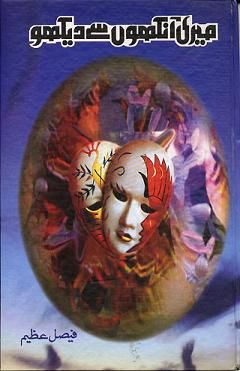
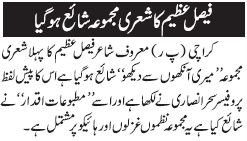
Mairee Aankhon Say Dhaikhoe; Look Through My Eyes...


From Cemendtaur, who is currently in Karachi:
'Meri AankhoN say dekho' (See it through my eyes), a book by young Bay Area poet Faisal Azeem has been published. The preface is written by Sahar Ansari. I will try to upload the title page and news of this publication. In Karachi, 'Meri AankhoN say dekho' is available at Welcome Book Port & Fareedsons, Urdu Bazaar; in North America, at this moment it is available through me--will try to put it at various online bookstores.

Congratulations to Faisal Azeem for reaching this very important milestone in his life.


آدابAdaab,
فقیر-iiFaqeer


Technorati tags applicable to this post: - - - -

Wednesday, February 22, 2006

Urdu Press: The Need to Come Out of Ghettos

Recently I came across an edit from the Times of India, which speaks, among other things, about the narrow and defeatist attitude the Urdu media (read Urdu dailies) has been exhibiting since long. This isn’t a good idea for the simple fact that Urdu media (like any other media) plays a very vital role in developing the mindset of its audience, which mostly comprise of the Urdu speaking Indian Muslims.

While it’s the responsibility of the media to highlight any lapses on the part of establishment, continuously brooding over the ‘pathetic state’ can go on to cultivate a negative mind frame of its readers, which can and does hamper the growth of community in particular and nation in general.

Instead of toeing a fanatically-religious and anti-secular line, the Urdu media must once again go on to become what is was during the revolution of 1857 i.e. free, secular, progressive, and above all revolutionary.

By changing its attitude, the Urdu media can very well be instrumental in breathing a new zest in its audiance.

As Iqbal would say: Teri Khudi main agar inqalaab ho paida, ajab nahi ke yeah chaar sou badal jayey.

BTW, in the edit I learned about Maulvi Mohammed Baqar, who was the first journalist to be martyred during the uprising of 1857. And yes, he was an Urdu journalist.

I am reproducing the TOI edit below for the benefit of readers:

http://timesofindia.indiatimes.com/articleshow/msid-1369931,curpg-1.cms

Every morning I open the Urdu newspapers with dread. Will I have to read yet another regressive rant by those who call themselves the custodians of Islam, or one more litany on the wrongs done to the Muslim community worldwide?

Sadly, the answer is yes. What better example of this kind of bigotry than the headline in the Urdu Times on January 9: 'Sharon ki maut par jashn manaya jayega' (Sharon's death will be celebrated)?

Muslims, madrassas, reservations in a Muslim university, a mosque under threat, another lavish one being built, Muslims being oppressed from Kashmir to Kandahar and Baghdad to Bradford, Bosnia, Palestine, Afghanistan.

These are the staples that Urdu dailies thrive on. It appears as if nothing else in the world is newsworthy unless it has Muslims at its centre, preferably in a situation of victimhood.

But a paper is a hard habit to break, no matter how parochial, bland or offensive. And it is also unfair to tar all the Urdu dailies with the same green brush.

But since Hyderabad's leading Urdu daily Siasat is hosting the World Urdu Conference between January 14 and 16, it is an excellent opportunity for leading dailies and their readership to do some introspection and take a hard look at the fare being dished out everyday.

This exercise might be more constructive than breast beating about the tardy treatment meted out to the Urdu language by an apathetic government.

Urdu, the epitome of our 'Ganga-Yamuni tehzeeb' (composite culture), is in its death throes. And nowhere is the decay more pronounced than its press, once the sentinel of freedom of thought and speech, mores and conduct. Urdu journalism prided itself on its glorious past.

If Maulvi Mohammed Baqar, an Urdu editor in Delhi, became the first Indian journalist who was martyred during the 1857 rising, Urdu journalists and writers like Maulana Azad, Maulana Mohammed Ali and Maulana Hasrat Mohani suffered rigorous imprisonment for opposing the British raj.

The spirit of Urdu, and its press, before it was trussed into a religious achkan, was secular, its tone revolutionary and progressive. It was never a language of the Muslims.

Munshi Prem Chand, Pandit Ratan Nath Sarshar, Krishen Chandar, Rajinder Singh Bedi and Josh Malsiyani were leading exponents of the language. How many Hindus does Urdu need to flaunt to prove its appeal across religions?

Urdu has enriched Hindi cinema immensely, providing mellifluous lyrics and embroidering dialogue. Yet regular reading of Urdu dailies is a lesson in looking at the world through the exclusive prism of Islam.

Like some Hindi rags, they too have begun to thrive on sensationalism. There are half a dozen leading Urdu dailies.

Interestingly, Hind Samachar, owned by a Hindu business family of late Lala Jagat Narain, is the largest circulated Urdu daily with a circulation of over one lakh. Urdu is historically linked with Indian Islam.

A bulk of Islamic tradition is in it. But to Islamise Urdu is to subvert the language's inclusive character — one that resulted from the intermingling of soldiers from different countries, which is why Urdu means camp.

Nobody paid a bigger price for Partition than Urdu. Pakistan, in its desperation to acquire legitimacy, appropriated Urdu and its poet Allama Iqbal.

Urdu became Pakistan's national language while Iqbal, who gave us Sare Jahan Se Achcha..., was turned into Pakistan's founder-thinker. Hindutva's hate-Urdu campaign became part of the anti-Muslim tirade.

The opportunist policies of the Congress governments only fuelled anti-Urdu campaigns. Urdu became a stranger in its own home.

Driven out of secular government schools, it found shelter in the insular, exclusivist madrassas and moribund maktabs. Like the commu-nity which patronised it, it became a minority.

It became the politicians' favourite plank to get Muslim votes. Dwindling revenue, caused by a shrinking readership, has pushed the Urdu press virtually into the hands of regressive forces.

There are some exceptions, but dissenting views and progressive ideas are mostly blacked out of the Urdu press. Is this issue also on the World Urdu Conference's agenda?


P.S. This edit appeared in the Times of India before the mentioned World Urdu Conference happened in Hyderabad, in the month of January, 2006.

Wednesday, February 15, 2006

PhotoBlogging Cartoon Protests in Karachi

For people who don't often get a chance to read banners in Urdu--or are nostalgic for it--here's an interesting chance:

As the protests against "Those Cartoons" move ("spread" doesn't seem appropriate) into Karachi, Pakistan's largest city, Cemendtaur is covering them on the Karachi Photo Blog. He's posting reports from the day on the Photo Blog. You can start at:

http://karachiphotoblog.blogspot.com/2006/02/cancel-your-trip-danish-cartoonists.html


and following on from there:

http://karachiphotoblog.blogspot.com/

Monday, February 13, 2006

Online Urdu Newspapers

Etemad - Hyderabad's youngest Urdu daily is already into circulation now. It is being brought out by a famous Muslim Ex-parliamentarian - Sultan Salahuddin Owaisi. Nasim Arifi has been appointed as the editor of Etemad.

Hyderabad already had three Urdu dailies - Siasat, Munsif and Rehnuma-e-Deccan. With the launch of Etemad, the quality of Urdu journalism is definitely going to improve, day by day.

Another good thing is that at least three of above mentioned newspapers also have their presence on the Internet. They can be read online on the following URLs are -

Aadaab,

~ Qais

Sunday, February 12, 2006

Urdu Tech News: "The Marriage of Google Mail and Google Talk"

I have mentioned Urdu Tech News here before:

http://urdu-ke-naam.blogspot.com/2005/09/urdu-tech-news-new-blog.html

I haven't been able to contribute to it much. But the other folks are doing good work, if a little slowly. And they're having fun with it! Take the following post; a headline like the one at the top of this post would not be out of the ordinary, right? But Shoaib Safdar has taken that and written pretty much the same thing in Urdu--with very interesting results! I guess it will take a while for us--or me, at least--to get so comfortable with this kind of thing in Urdu to take this kind of thing in my stride. Until then, it's rather endearing; enjoy!

http://urdutechnews.blogspot.com/2006/02/blog-post.html

I mean, the traditional way to say that would be "GMail aur Google Talk ka milaap", but Shoaib takes it a step further, to "GMail aur Google Talk ka biyaah".

Hey, what can you do! It's a brave new world, this blogosphere; and new ways of expressing ourselves are the whole point, no?

آدابAdaab,
فقیر-iiFaqeer

Tuesday, December 20, 2005

DoorDarshan Urdu Update

We'd talked about DoorDarshan staring an Urdu channel:

http://urdu-ke-naam.blogspot.com/2005/07/urdu-news-channel-by-prasar-bharti.html

Here's an update:

http://www.indiantelevision.com/headlines/y2k5/dec/dec161.htm

It's taken almost three generations, but it is good to see Urdu increasingly getting its props in India. We need to get to the point where the culture that the language represents really rises above the divide between India and Pakistan. Yes, I know we cherish poets across the border and give them great honors when they visit; but that's my point. We need to get to the point where it is not mentionable that a poet is Indian or Pakistani. When a poet from Britain visits the US or Australia, or vice versa, it is not a big deal which country he or she is from; he is a great poet in the language spoken in both places. That's how it should be.

Monday, October 31, 2005

Azad Karachi Radio Program 003, October 31, 2005

Program 3 of Azad Karachi Radio continues discussion of the earthquake in South Asia and discusses issues of democracy, civilization and the role of the World Bank and the Military.

You can hear the program, or get information on how to subscribe to the Podcast here.

آدابAdaab,
فقیر-iiFaqeer

Friday, October 28, 2005

Siasat Group: A Vanguard for Urdu

Siasat, an Urdu daily published from Hyderabad, has been a vanguard in the world of Urdu media and journalism. It was also the market leader in terms of readership, till one Munsif Daily made a heroic comeback - after it was taken over by a Chicago based businessman - and gave Siasat a tough competition.

Siasat was founded by a philanthropist and educationist - Abid Ali Khan, the man who dedicated his life for the welfare of the masses. Mr. Khan had the vision of promoting social welfare and harmony, and for the purpose Siasat Daily was very much instrumental. For his contribution to his community and the country, he was awarded with one of the prestigious civilian award by the Govt. of India - "Padmashree."

Among other remarkable things that the Siasat Group is involved in, one of their works is highly commendable i.e., the education of Urdu. Today, the group is, in itself, an institution of Urdu. It's not only involved in promoting Urdu education, but is also involved in organizing related cultural activities, like "Mushairas" - a gathering of poets.

To my knowledge, the Group runs Abid Ali Khan Educational Trust Urdu Classes, where tremendous effort are made for educating students in Urdu. Things like Urdu Calligraphy, Urdu Software, etc is taught to the students interested in the language.

Other than Urdu, the Siasat Group continues its good work on many social fronts. Visit the webpage below to read a note from Siasat's current Editor in Chief: Mr. Zahid Ali Khan.

http://www.siasat.com/english/index.php?option=content&task=view&id=63&Itemid=75&cattitle=Useful%20Links

Siasat's online edition: http://www.siasat.com/

Thursday, October 20, 2005

Azad Karachi Radio Program 002 now available

The second program of Azad Karachi Radio (I mentioned it last week) has just been uploaded. Please take a look and provide feedback:

Azad Karachi Radio is an Urdu language audio program available on the web. Published under the Azad South Asia banner, this program covers, politics, poetry, and life. The first two programs are now available at:

http://AzadKarachiRadio.blogspot.com


You can subscribe using podcasting software using the address:

http://feeds.feedburner.com/AzadKarachiRadio

Azad Karachi Radio is also available for online listening via Yahoo!s new (Beta) Podcasting service at:

http://podcasts.yahoo.com/series?s=3d848ad579b260b163d17218e7fcbad5

آدابAdaab,
فقیر-iiFaqeer

iFaqeer on Sahir Ludhianvi; Now in Audio

As a pilot for podcasting on my personal blog, I took the speech I gave a little while ago on Sahir Ludhianvi (see this and this), stuck an English introduction at the beginning and uploaded it. You can hear it here.

آدابAdaab,
فقیر-iiFaqeer

Thursday, October 13, 2005

Urdu Blogs on the 'Quake

As some readers will know, there's now an extensive section about the quake-related information on WikiPakistan. (See my post on my personal blog.) One of the pages there collects personal accounts from the ground:

http://pakistan.wikicities.com/wiki/Earthquake_10-05_Personal_Accounts


Wouldn't it be a good idea to collect links there to Urdu (and English) blogs of people on the ground, both affectees and those involved in relief work, fundraising, etc.? It would give Urdu-speakers (and other people) around the world a chance to get a first hand view.

آدابAdaab,
فقیر-iiFaqeer

Tuesday, October 11, 2005

Azad Karachi Radio; a New Urdu Language Podcast

We've launched a new Urdu Language Podcast with the title "Azad Karachi Radio". Check it out at:

http://AzadKarachiRadio.blogspot.com/

You can subscribe to the RSS feed using the following address:

http://feeds.feedburner.com/AzadKarachiRadio

Please let us know what you think.

For Azad South Asia,

آدابAdaab,
فقیر-iiFaqeer

Wednesday, September 21, 2005

"Installing Urdu" on Windows XP

This blogger, in particular, has made a lot of noise about blogging in Urdu and I promised instructions on how to install Urdu as a language that your Windows XP machine can handle. Here are the instructions, from the website of the Center for Research in Urdu Language Processing in Pakistan:

http://www.crulp.org/Downloads/read_me_xp.txt

Once you have followed those instructions, you can use Urdu not just for blogging, but for pretty much anything you now use English and the English script for on your computer. And as I have said before, no, it is not the same as using InPage or some other editor to write Urdu, but using Urdu all the time. With the InPage solution (which is wonderful for "kitaabath" and page layout), what you have to do is convert your text in to a graphic and put it on your website or page, etc. But with this procedure, you can actually write directly in your HTML file, or Word document--or even while chatting with people over Yahoo! Messenger, MSN Messenger or other IM client!

آدابAdaab,
فقیر-iiFaqeer